
Weeks Passed. Nothing Changed
Here’s a situation that plays out every day in hospital billing departments:
A patient notices a duplicate charge on a hospital bill and calls the billing department to report it.
The representative promises to review the account, but weeks pass and nothing changes.
A second phone call produces the same response. Only after the dispute is submitted in writing does the account enter a formal review process.
This situation is more common than most people realize.
The bill may not be enormous.
In many cases, the problem isn’t the total amount.
It’s a charge that doesn’t seem to belong there — a duplicate lab fee, a service billed twice, or a billing code that doesn’t match what the patient remembers receiving.
The patient calls the billing department.
The representative is polite and promises to review the account.
Three weeks later, the same bill arrives.
Same amount.
No correction.
Another phone call leads to the same answer:
“I’ll make a note of that.”
Eventually, a formal written dispute is submitted.
Only then does the account enter a documented review process.

Why Phone Calls Usually Don’t Work
This isn’t a knock on billing department staff. Most of them are doing their jobs. The problem is structural.
Hospital billing departments handle hundreds of accounts. When you call to dispute a charge, a front-line rep makes a note in the system — if they remember to. That note may or may not get reviewed. It may or may not be escalated. There’s no formal process triggered. No deadline set.
A written dispute is different for one reason: it forces the hospital to respond.
⚠️ What Most People Get Wrong
Calling to dispute a charge feels productive. It isn’t — not on its own. Unless you follow up with written documentation, the billing department has no formal obligation to correct anything.
Verbal requests disappear. Written disputes create a paper trail that protects you if the error ends up in collections.
Before You Write Anything: Gather These 3 Documents
Don’t write the dispute letter until you have all three of these in front of you. Without them, the hospital can delay resolution indefinitely by saying they need “more information.”
📋 The 3 Documents You Need
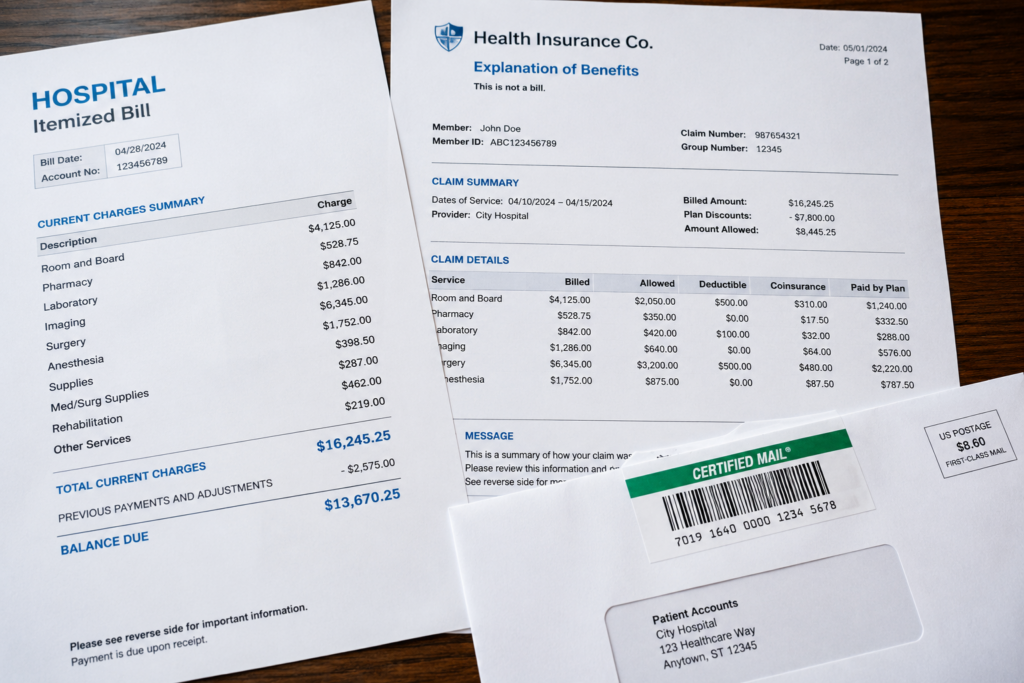
1. The Itemized Bill
Not the summary bill — the line-by-line breakdown of every charge, with CPT codes and dates of service. Call the billing department and ask specifically for the “itemized bill.” If they say you already have it, ask for the version that shows individual CPT codes.
2. Your Explanation of Benefits (EOB)
This comes from your insurance company, not the hospital. Log into your insurance portal or call member services to request it. The EOB shows exactly what your insurer approved — and what they didn’t. Any discrepancy between your EOB and your hospital bill is grounds for dispute.
3. Your Account Number
Found on any bill from the hospital. Every piece of correspondence needs this number, or the billing department will claim they can’t locate your account.
The Dispute Letter: What to Include
Keep it short. Keep it factual. Don’t apologize, and don’t get emotional — billing departments respond to documentation, not frustration.
Your letter needs five things:
1. Your full name, account number, and date of service. Put these at the top. Every time.
2. A clear statement that you are disputing a specific charge. Name the charge, the amount, and the line item number from your itemized bill.
3. The reason for the dispute. One sentence is enough. “This charge appears twice on my itemized bill, but my EOB shows only one approved service on this date.”
4. What you’re requesting. “I am requesting a corrected bill reflecting the removal of the duplicate charge.”
5. A response deadline. “Please respond within 30 days.” This matters more than most people realize — it establishes that you expect a response and sets a clock.
✉️ Dispute Letter Template
[Your Name]
[Your Address]
[Date]
Billing Department
[Hospital Name]
[Hospital Address]
Re: Formal Billing Dispute — Account #[XXXX] — Date of Service: [XX/XX/XXXX]
To Whom It May Concern,
I am writing to formally dispute a charge on my account referenced above. After reviewing my itemized bill and Explanation of Benefits from [Insurance Company], I have identified the following discrepancy:
[Describe the specific charge: e.g., “Line item #14 on my itemized bill shows a charge of $425 for CPT code 80053 (Comprehensive Metabolic Panel) dated [date]. This same charge appears again on line item #22 for the same date and amount. My EOB confirms only one service was approved on this date.”]
I am requesting a corrected bill reflecting the removal of the duplicate charge. I have enclosed copies of my itemized bill (with the disputed charges highlighted) and my EOB for your reference.
Please respond in writing within 30 days of receiving this letter. I can be reached at [phone number] or [email address].
Sincerely,
[Your Name]
[Account Number]
[Phone Number]
Send via certified mail with return receipt. Keep a copy of everything.
How to Send a Medical Bill Dispute Letter
Email feels easier. Don’t use it for the initial dispute.
Send the letter by certified mail with return receipt requested. This gives you proof of delivery — the date it arrived, and a signature confirming someone received it. If the dispute eventually goes to collections or you need to file a complaint, that proof becomes critical.
Keep copies of everything: the letter, the enclosures, the certified mail receipt.
What Happens After You Send It
In most cases, one of three things happens:
The hospital corrects the bill. This is the most common outcome when the error is clear and well-documented. You’ll receive a corrected statement, usually within 2 to 4 weeks.
The hospital requests more information. They may ask for additional documentation. Respond promptly and in writing.
You hear nothing. If 30 days pass with no response, follow up with a phone call — and reference the certified mail tracking number. Then send a second letter if needed.
📞 The Follow-Up Phone Script
You: “Hi, I’m calling to follow up on a written billing dispute I submitted on [date]. My account number is [XXXX]. I sent it via certified mail — the tracking number shows it was received on [date]. I haven’t received a response yet and wanted to confirm it’s been assigned for review.”
If they can’t find it: “I have the certified mail tracking number and return receipt if that helps locate it. Can I speak with a billing supervisor?”
Write down the name of whoever you speak to and the date of the call.
If the Dispute Gets Denied
Don’t stop at the billing department. You have two more escalation options before involving outside parties.
Ask for a Patient Advocate. Most hospitals have one on staff. Their job is to mediate between patients and billing — and they often have more authority to resolve disputes than front-line billing staff.
File a complaint with your state’s insurance commissioner if the dispute involves an insurance coverage issue. For federal protections like the No Surprises Act, contact the No Surprises Help Desk at 1-800-985-3059.
Navigator Alex Tip

One detail that often changes the outcome is sending the dispute by certified mail.
Not because it’s legally required, but because it creates proof that the dispute was received.
A certified letter signals that the patient is documenting the process and keeping records.
If a dispute becomes delayed, escalates, or is later questioned, that paper trail can become extremely valuable.
Related Guides — Fight Your Bill
More tools to dispute charges and protect yourself from billing errors.
1. How to Request an Itemized Bill — Get the line-by-line breakdown before you write anything.
2. Common Hospital Billing Errors — Know what to look for before you dispute.
3. Script for Disputing a Medical Bill on the Phone — For when you need to call, not write.
4. What is the No Surprises Act? — If the charge involves an out-of-network provider, federal law may already protect you.
5. Medical Debt in Collections? — If the bill moved to collections before you could dispute it, you still have options.
Disclaimer: This article is for educational purposes only and does not constitute legal or financial advice. Billing dispute processes vary by hospital and state. If you are facing legal action over a medical bill, consult a qualified consumer protection attorney.