
The $3,000 Stitch: Navigating the “Facility Fee Trap”
In the U.S. healthcare system, a simple kitchen accident isn’t just a medical event—it’s a financial crossroad. That single nylon thread used to close a minor gap costs the hospital pennies, but depending on which door you walk through, that same thread can be billed at a 1,000% markup.
Most patients rush to the Emergency Room (ER) out of instinct, unaware that they are walking into an information asymmetry designed to maximize billing through “Facility Fees.” As your Care Navigator, I’m here to bridge that gap and show you how to get the care you need without falling into a debt trap.
The Billing Architecture: Why the ER Costs 10x More
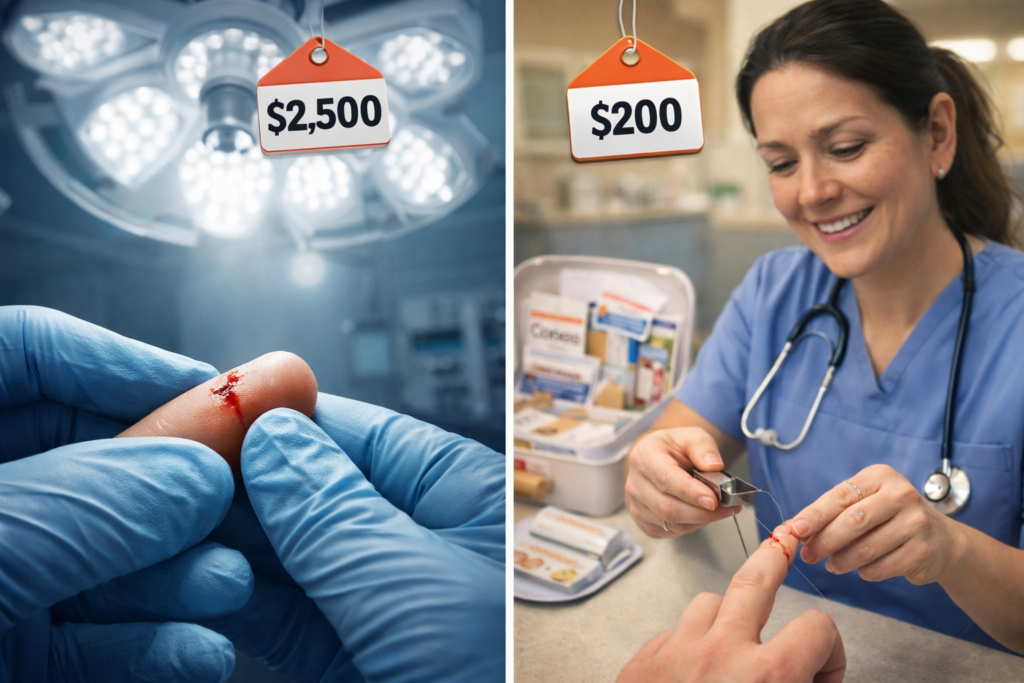
The primary difference between a $300 bill and a $3,000 bill isn’t the quality of the doctor—it’s the Billing Architecture. When you enter an ER, you are charged a “Facility Fee” (often coded as CPT 99281-99285) just for occupying the space. This fee exists to support the 24/7 overhead of a trauma center, even if you only need a 5-minute stitch.
💰 Price Tag Comparison (Average Uninsured/Self-Pay)
-
🏥 Emergency Room (ER): $1,500 – $3,500+
Includes Facility Fee ($1,200+), Professional Fee, and Supply Markup. -
🩺 Urgent Care Center: $150 – $450
Usually a flat-rate or simple tiered billing for “Simple Repairs” (CPT 12001).
Cost-Benefit Analysis: Where is the ER Premium Justified?
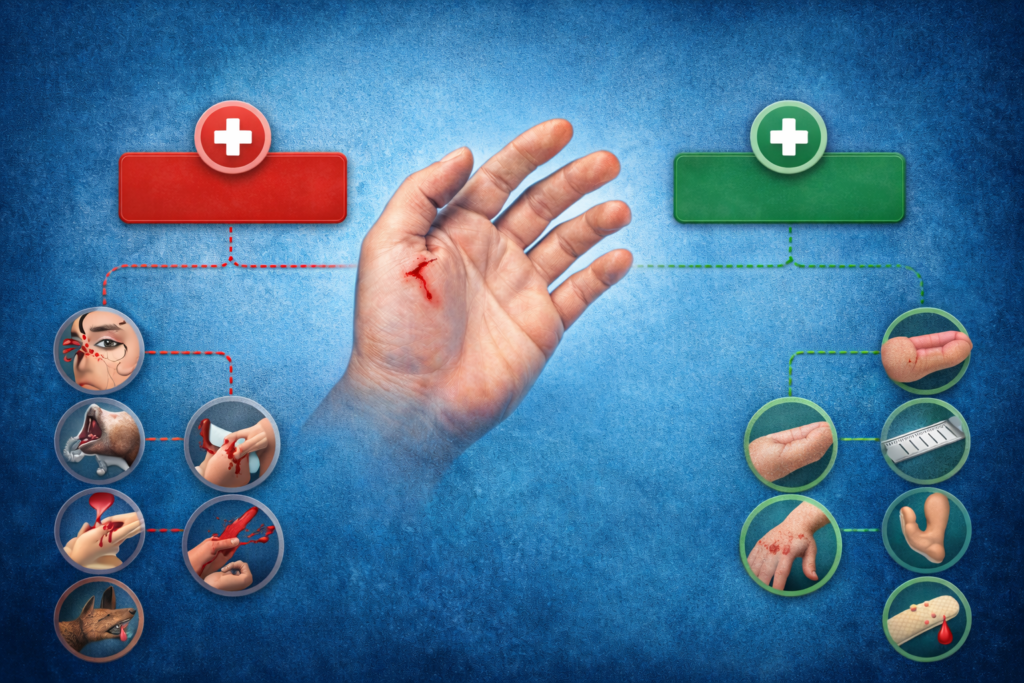
While we want to optimize for cost, certain injuries carry high Aesthetic or Functional Risks that justify the ER’s premium “Facility Fee.” Use this administrative guide to choose the right tier of care.
🚨 High-Value ER Cases
When professional specialization outweighs cost concerns:
- Facial Integrity: Cuts on eyelids, lips, or nose where a Plastic Surgeon is needed to prevent permanent value loss (scarring).
- Complex Coding: Wounds where you can see muscle, fat, or bone (requires CPT 12031+ “Intermediate/Complex Repair”).
- Functional Loss: Inability to move fingers/toes, suggesting tendon involvement.
- Uncontrolled Hemorrhage: Bleeding that won’t stop after 15 minutes of direct pressure.
✅ Urgent Care: Best ROI
Ideal for “Simple Repairs” (CPT 12001-12007):
- Linear Cuts: Straight kitchen accidents on hands, arms, or legs.
- Clean Margins: Edges are sharp and straight, not crushed or jagged.
- Time Sensitivity: Injury occurred within the last 12-24 hours.
- Standard Tetanus Needs: Most Urgent Cares stock low-cost Tetanus boosters.
Strategic Negotiation: The CPT Code Defense
If you have already visited the ER for a simple cut and received a massive bill, don’t pay immediately. This is where Billing Audit tactics come into play. Request an Itemized Statement and verify the codes.
- Check for “Upcoding”: Simple stitches on extremities are typically coded as CPT 12001 through 12007. If you see a “Complex Repair” code for a 2-stitch finger cut, you have leverage to dispute the bill.
- Dispute the Acuity Level: Hospitals often charge a “Level 5” ER Visit (CPT 99285) for simple procedures. You can contest this by stating: “The acuity of this visit does not meet the CMS criteria for a Level 5 facility charge.”
Navigator Alex Tip
If you choose Urgent Care for a clean, straight cut, ask: “Is this a candidate for medical glue?” It is often faster, billed similarly to stitches, and eliminates the need for a follow-up visit to remove sutures—saving you an additional co-pay or office visit fee.
Administrative Disclaimer
This article is for educational and financial optimization purposes only. I am a Healthcare Navigator specializing in billing frameworks, not a licensed medical professional. If you are experiencing uncontrolled bleeding, loss of consciousness, or a deep trauma, clinical safety must take absolute precedence over financial optimization. Cost estimates are regional averages and can vary significantly by facility and insurance plan.